Run claude,
gemini and
codex side-by-side -
each in its own git worktree.
Free and open source (AGPL-3.0). Spawns the CLIs you already have installed, in PTYs. Stays on your existing Claude Pro / Max plan - off the new $200 Agent SDK credit pool.
Free forever · AGPL-3.0 · macOS · Linux + Windows soon
Free · Open source · AGPL-3.0
Termic is free. The CLIs run on the plan you already pay for.
No license, no tier, no seat math. Termic itself is free and open source - AGPL-3.0, source on GitHub. It just spawns the CLI binaries you already have. They use whatever auth they already use: Claude Pro / Max for claude, Google's plan for gemini, your OpenAI login for codex. On June 15, 2026 Anthropic moved the Claude Agent SDK (plus claude -p, GitHub Actions, and third-party harnesses) onto a separate $200/mo credit pool at API list prices. The interactive claude CLI - the one Termic spawns - stayed on the regular subscription.
01
Free, open source, AGPL-3.0
Termic itself costs nothing and never will. Source is on GitHub. Fork it, audit it, package it - derivatives stay AGPL, which is what keeps the next 'open core' tool from quietly going proprietary.
02
Off the SDK credit meter
Tools built on the Claude Agent SDK bill against the $200/mo credit pool at API rates. Termic spawns the interactive claude CLI directly - the one Anthropic kept on the regular subscription. No per-token markup, no surprise invoice.
03
The best harness is their own harness
Anthropic / Google / OpenAI ship features in their CLIs first - that's where their teams put the work. SDK wrappers chase it. Termic just runs the CLI, so the day a model upgrades or a slash-command lands, you're using it.
Why no SDK actually matters
/Always up to date - by definition
claude / gemini / codex ship features in their CLIs at the pace of their core teams. Termic doesn't reimplement any of that; it spawns the binary you already have. New flag today → in Termic today.
/Your existing auth, your existing plan
claude reads ~/.claude. codex reads its own login. gemini stays signed in with Google. Termic doesn't intercept tokens or route through anything - same CLI you'd run in iTerm.
/Real PTYs
The agent's TUI renders the way it does in your shell - animations, slash-commands, /resume pickers, bell rings, the lot. xterm.js + wezterm's portable-pty under the hood.
/Survives CLI rewrites
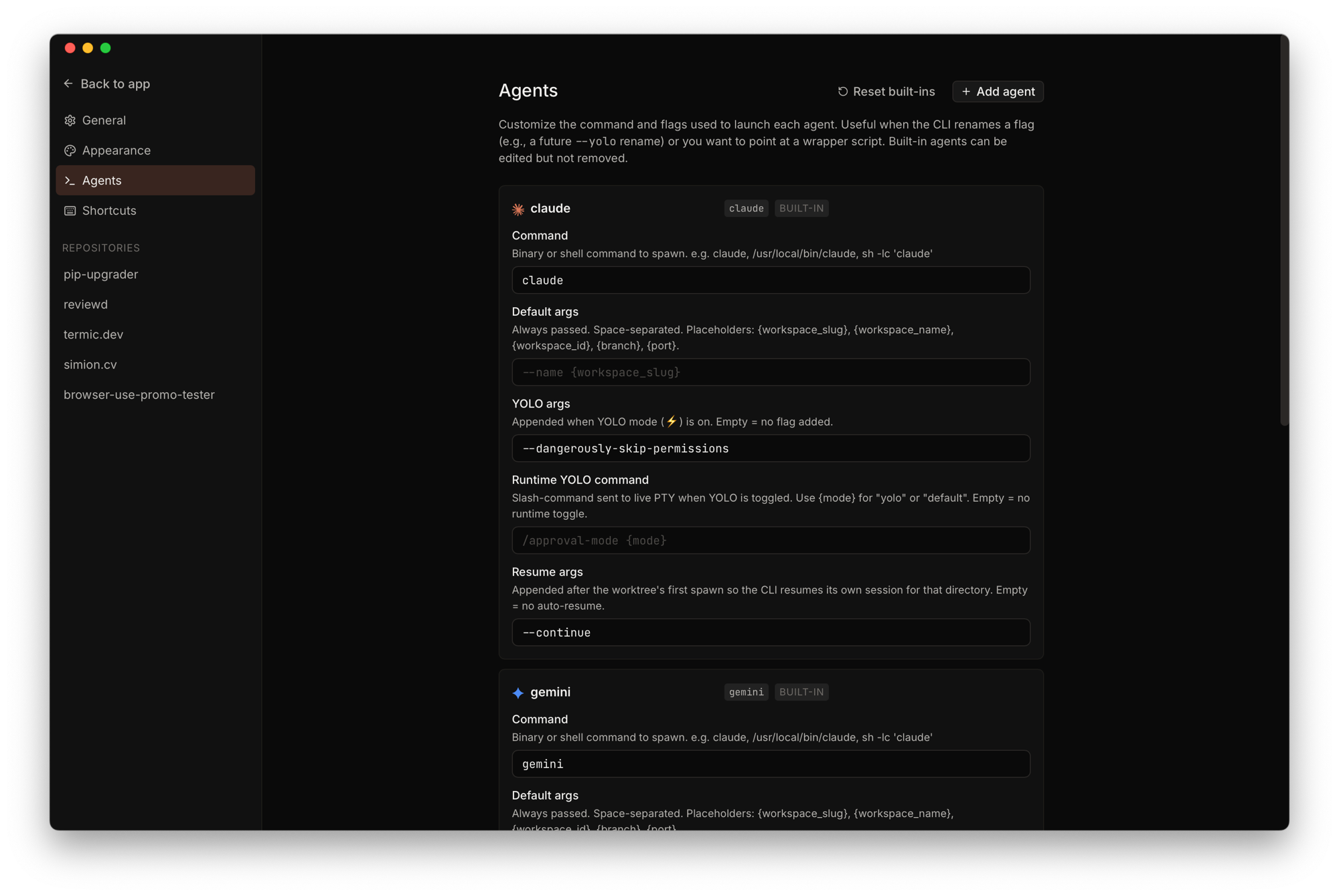
If Anthropic ships an entirely new agent binary tomorrow, edit Settings → Agents and point the entry at it. No release of Termic required.
parallel by design
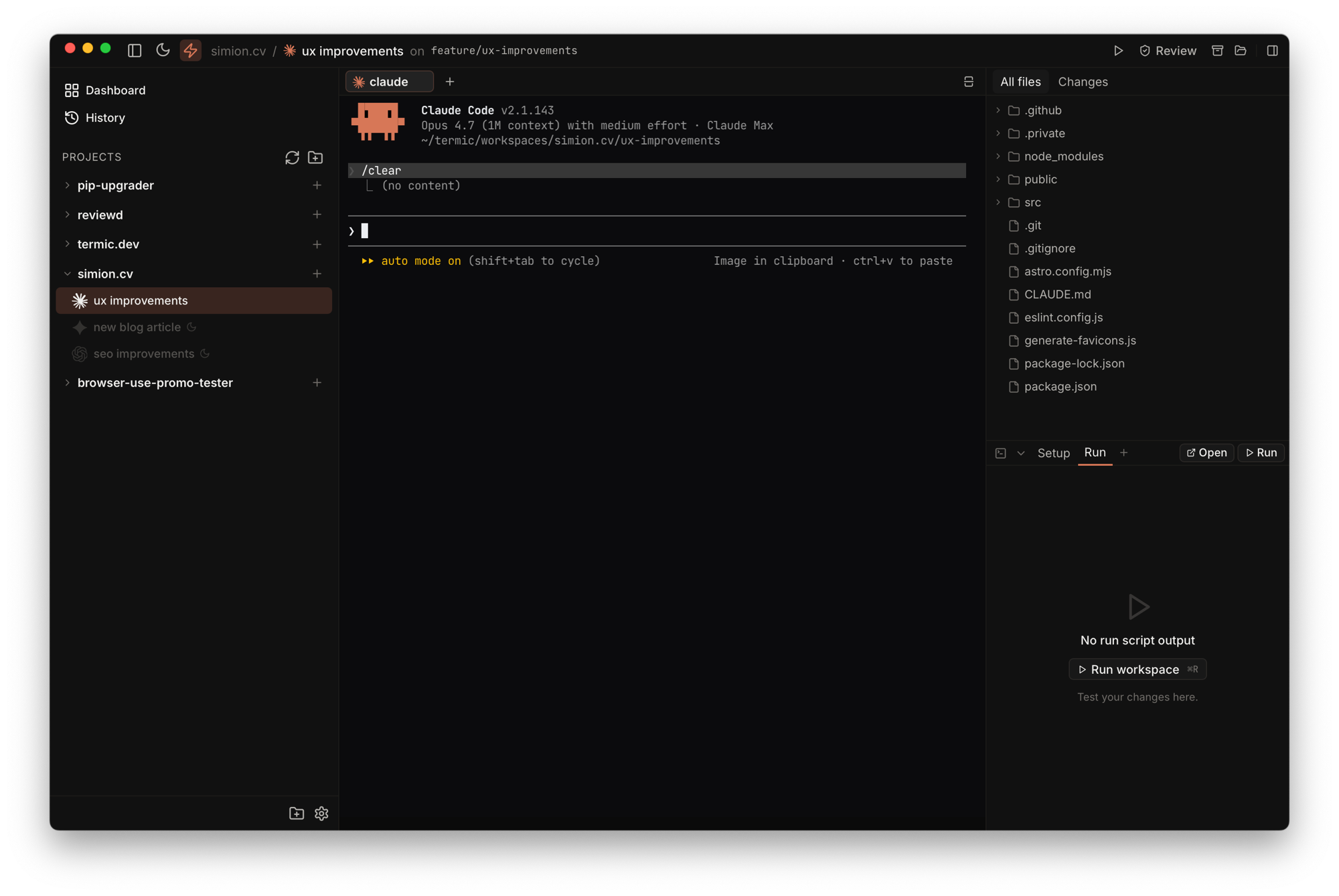
A worktree per agent. A port per worktree.
Each workspace is a git worktree - separate working copy, own branch, own dev port. Three agents on the same project don't share state; they don't compete for port 3000.
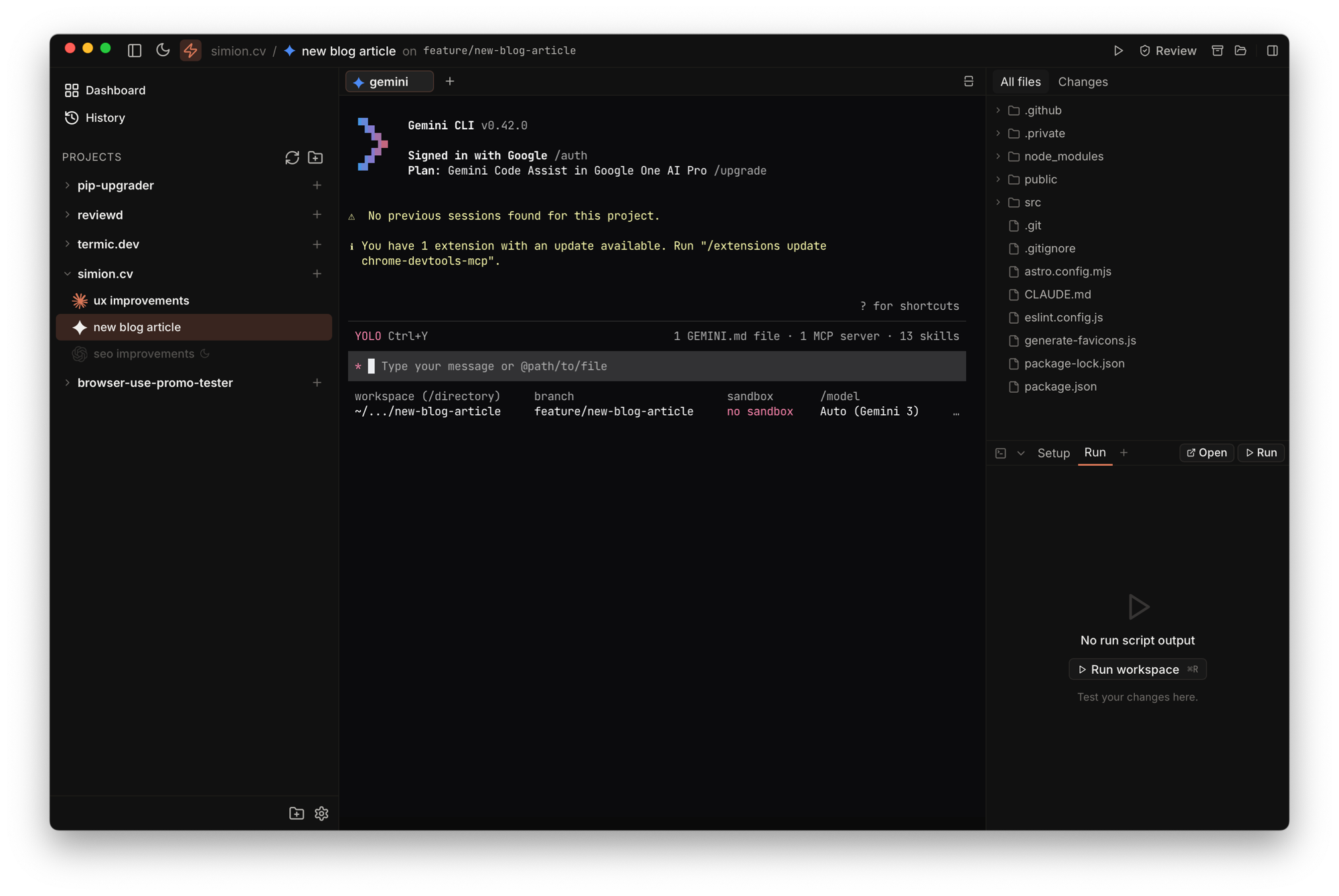
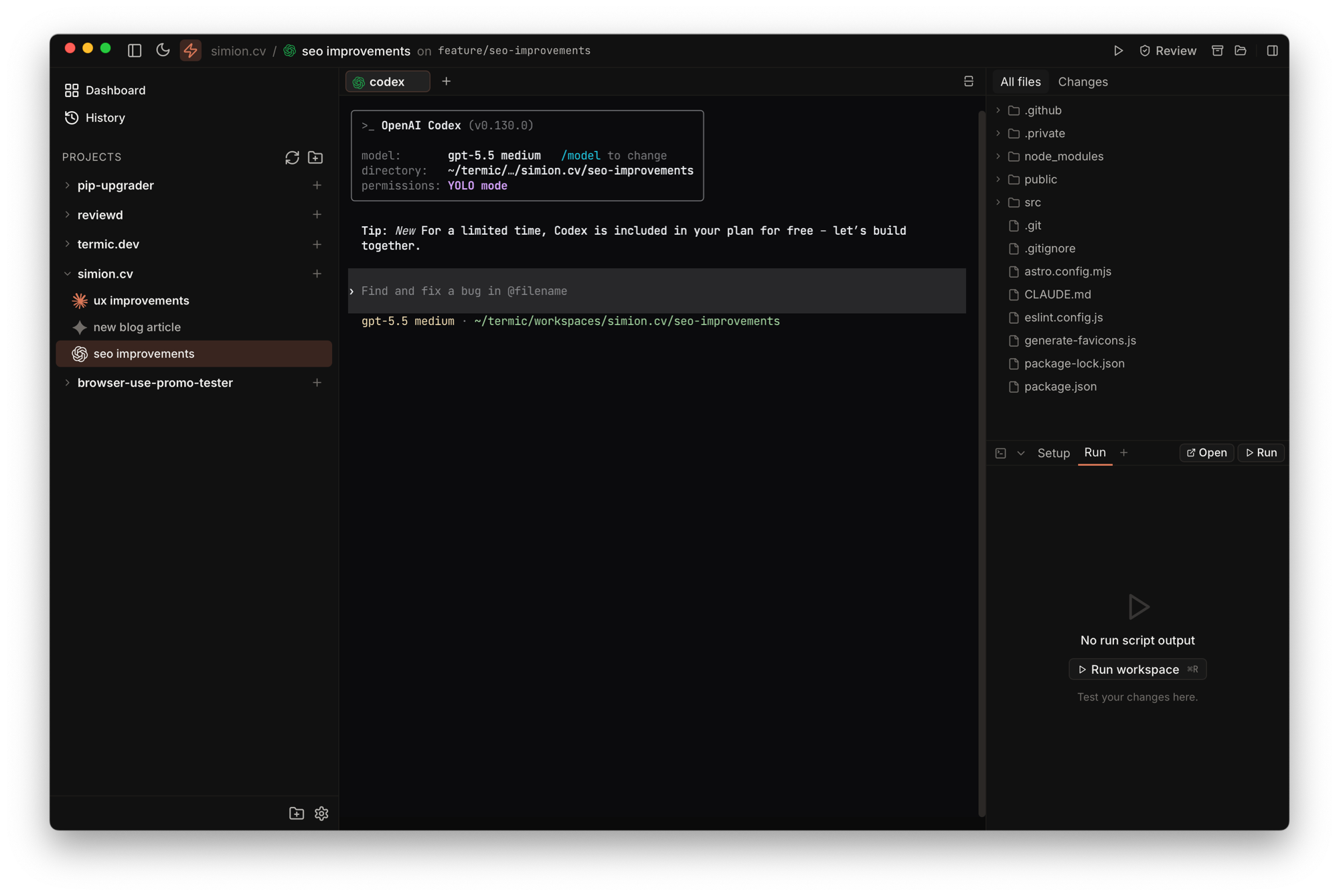
All three sit in the sidebar at once. PTYs stay alive on switch, so copying a snippet from gemini to claude doesn't disconnect or reload anything.
multi-agent
Three CLIs in one workspace
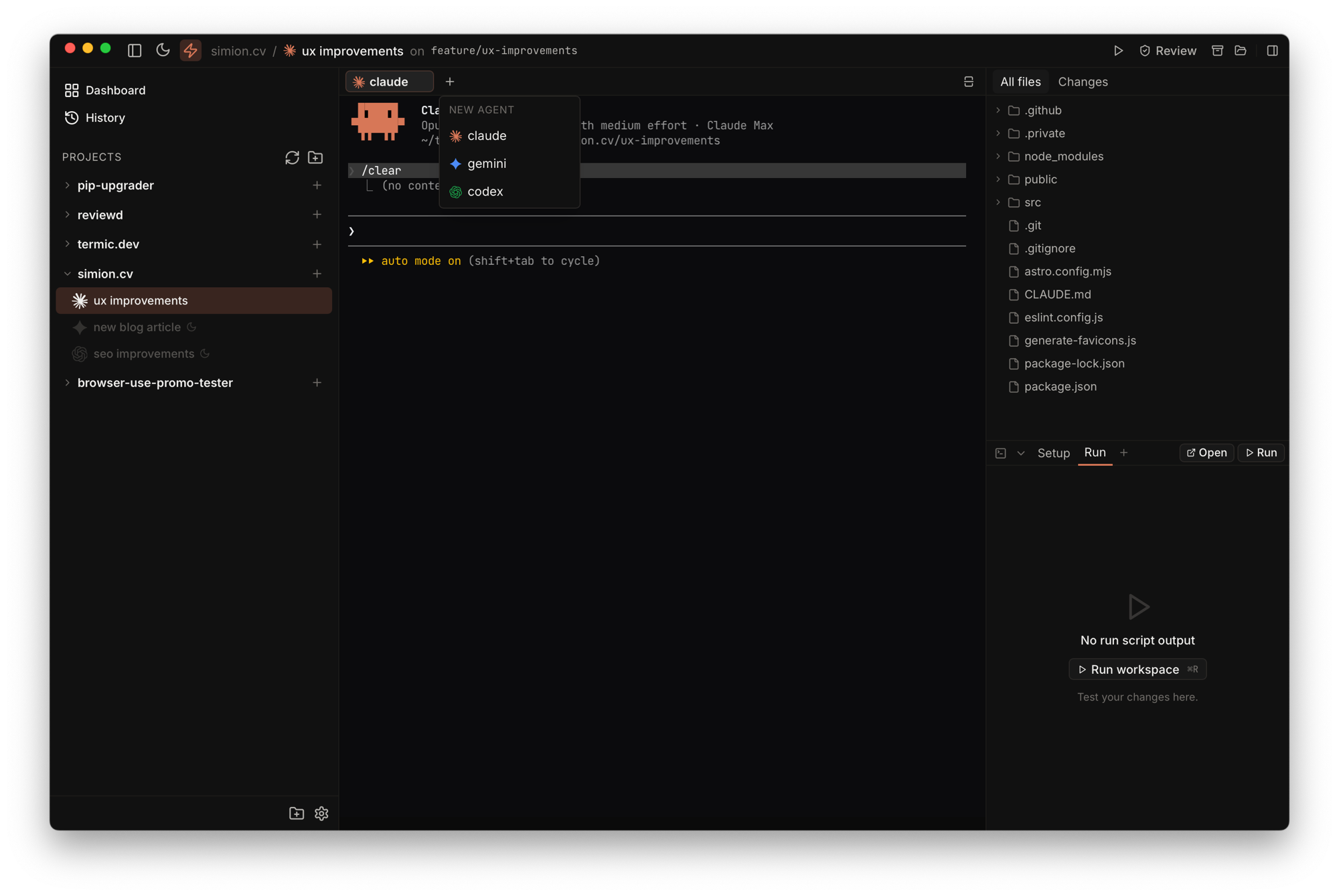
Multiple tabs per workspace, each running a different agent. Useful when you want gemini to second-guess what claude wrote, or to hand a chore off to codex while the other two are busy.
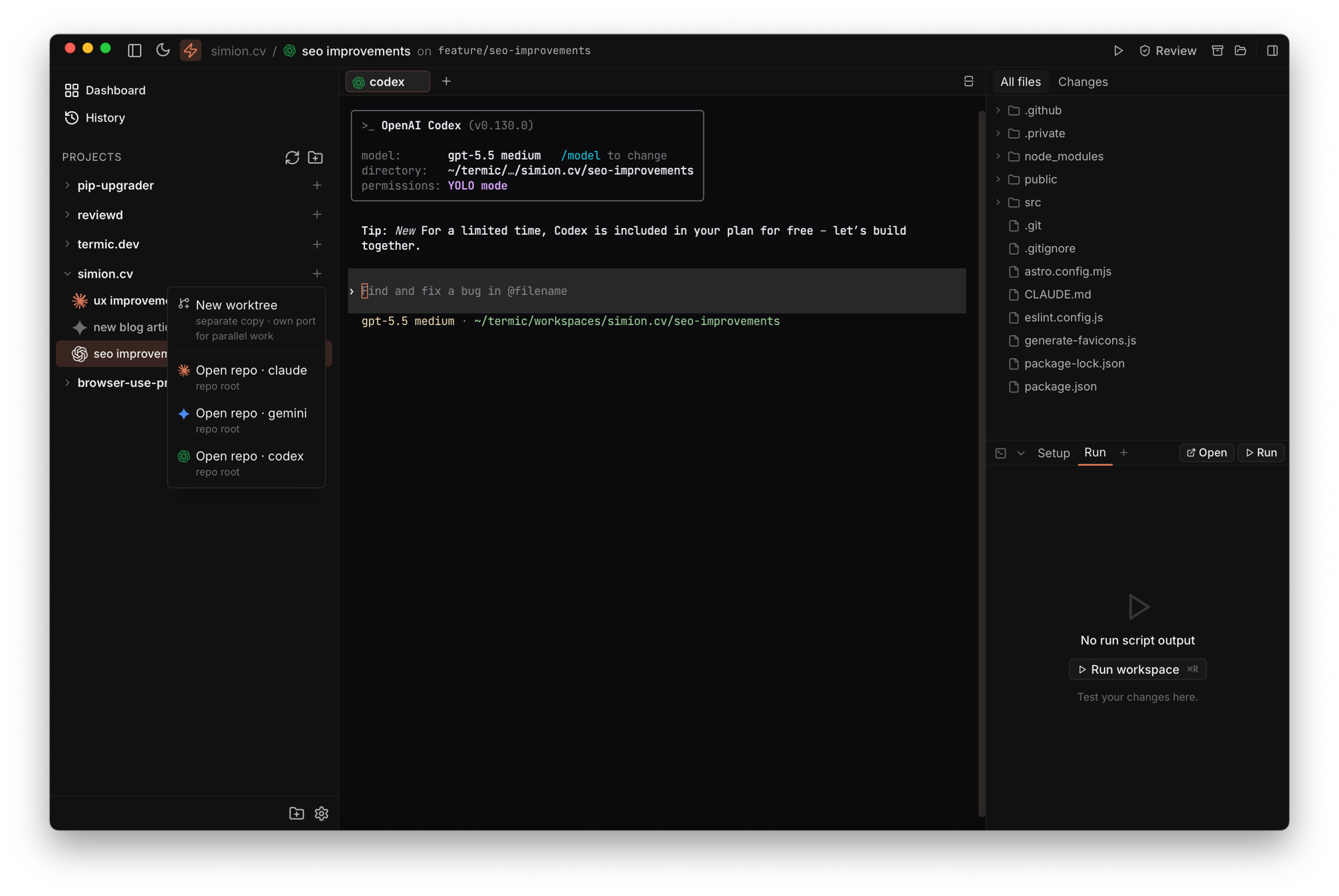
Custom agents go in Settings → Agents - point at any binary or wrapper script and it shows up in this menu.
workspaces
Branch off, or stay on main
New worktree creates a separate copy on disk, branched off your default. Run a dev server on a unique port, ship a feature, archive when done.
Open repo attaches an agent to your actual checkout - for one-off questions, README edits, the kind of small thing that doesn't deserve a branch.
You don't need parallel work to get value out of Termic. Even with a single project on a single branch, the app gives you tabbed agents, a built-in editor and diff view against HEAD, a Run/Setup panel that streams your dev server, and one-click claude --resume / codex resume --last per workspace. It's a better day-to-day shell for the CLI you're already running.
configurable
The agent registry is just JSON
Command, args, YOLO flags, resume flags - all editable per agent. When a CLI changes a flag, you fix it in 30 seconds. When you want to point claude at a wrapper script that injects extra env vars, you do that too.
Templated placeholders like {workspace_slug},
{branch}, {port} expand
per-worktree at spawn time.
under the hood
Native desktop, web rendering
Tauri shell, web frontend. Editor and terminal are off-the-shelf libraries we picked after benching alternatives in WKWebView.
Rust backend, WKWebView frontend. ~10MB bundle (vs Electron's ~120).
UI. Vite HMR for dev, single bundle for prod.
Editor. ~150KB; Monaco was slower in WKWebView when we tested.
Terminal. WebGL renderer was the only one without visible row gaps in TUI apps.
PTYs on macOS / Linux / Windows. Same crate Wezterm itself uses.
State. No reducers, no thunks - just hooks.
questions
The actually-asked questions
Skipping the marketing FAQ stuff. Real questions, plain answers.
Does this work with my Claude Pro / Max subscription?
claude CLI - same binary you'd run in iTerm, same auth, same quota. Anthropic kept interactive Claude Code on the subscription when they split the Agent SDK into its own credit pool on June 15, 2026.How is this different from Conductor.build?
claude -p, GitHub Actions, and third-party harnesses) bills against a separate $200/mo credit pool at API list prices. Termic doesn't touch the SDK - it spawns the CLI binary directly, which stays on the regular subscription.What about gemini and codex?
gemini (Google login, Gemini Code Assist plan) and codex (your OpenAI Codex login). Whatever auth those CLIs already use on your machine, Termic inherits - nothing to set up.What happens when claude / codex / gemini ship a new feature?
Does Termic see my prompts or read my code?
tail -f it if you want to see what's happening) - that's all.What's a git worktree, why does it matter here?
.git. One per workspace means three agents can edit the same project in parallel without stomping each other's files, and each gets a unique dev port so they don't fight over 3000.Is it actually open source?
Linux and Windows?
Stop paying twice for the same agent.
Free, AGPL-3.0. macOS now; Linux and Windows soon.