Run claude,
codex,
agy +5 more
each in its own git worktree.
Every new feature the day they ship it.
Termic spawns the real CLIs in PTYs. claude, codex, antigravity, copilot, grok, opencode, pi and Meta's muse ship built in; when any of them updates, you get the update, no wrapper to catch up. Add your own in 30 seconds: aider, ollama run, anything that runs in a PTY. Free, open source (AGPL-3.0), running the real CLI instead of a wrapper.

Free · Open source · AGPL-3.0
Termic is free. CLIs run on your existing plan.
Termic spawns the CLI binaries you already have - claude, gemini, codex - and inherits their auth. Anthropic's June 15, 2026 Agent SDK credit change is scheduled to apply to the SDK path (plus claude -p, the GitHub Actions integration, and third-party apps that authenticate through the SDK). The interactive claude CLI - the one Termic spawns - stays on the regular Pro / Max subscription usage limits.
01
Free, open source, AGPL-3.0
Termic itself costs nothing and never will. Source is on GitHub. Fork it, audit it, package it - derivatives stay AGPL, which is what keeps the next 'open core' tool from quietly going proprietary.
02
The interactive CLI path
Termic spawns interactive claude directly, the same path you'd use in a terminal. It is not on the SDK credit meter. No per-token markup, no hidden proxy, no custom agent loop between you and the vendor CLI.
03
The best harness is their own harness
Anthropic / Google / OpenAI ship features in their CLIs first - that's where their teams put the work. SDK wrappers chase it. Termic just runs the CLI, so the day a model upgrades or a slash-command lands, you're using it.

tasks
Main checkout, or a fresh worktree
Main checkout attaches an agent to your actual checkout - for one-off questions, README edits, the kind of small thing that doesn't deserve a branch. It's the default, and where most people start.
Worktree creates a separate copy on disk, branched off your default (the branch name is filled in for you, editable inline). Run a dev server on a unique port, ship a feature, archive when done.
You don't need parallel work to get value out of Termic. Even with a single project on a single branch, the app gives you tabbed agents, a built-in editor and diff view against HEAD, a Run/Setup panel that streams your dev server, and one-click claude --resume / codex resume --last per task. It's a better day-to-day shell for the CLI you're already running.
Tasks & worktrees, in depth →daily driver
Search, multi-repo, terminals, broadcast
The billing math gets you to install Termic. This is the stuff you touch every day. All of it works on a single repo and a single branch, no parallel work required.
/Multi-repo task
Add api/, web/ and infra/ to one task and the agent works across all of them at once. Drop a shared CLAUDE.md describing every repo and its structure, and you develop end to end without re-explaining the layout each session.
/Fuzzy file search (Cmd+P)
Cmd+P opens a Sublime-style fuzzy finder backed by git ls-files. It only sees tracked files, so it stays instant on big repos and never wanders into node_modules.
/Find in files (Cmd+Shift+F)
Project-wide search via git grep. Already indexed by git, respects your .gitignore, stays fast on large repositories. No separate indexer to install or babysit.
/Terminal tabs, your launch command
Not every tab needs an agent. Open a plain terminal, or one that boots straight into a command you set. Keep k9s --context= per cluster in the sidebar and every environment is one click away.
/Broadcast to many agents
Send one message to several agents in a task at once. Ask the same question across claude, gemini and codex, then compare how each answers before you commit to an approach.
/.termic.yaml, committed to the repo
Scripts, run commands, preview URL and the sandbox allowlist live in a .termic.yaml in your repo. A teammate clones, opens Termic, and the setup is already there. Nobody rebuilds your config by hand.
/Know which agent needs you
A blue dot lands on a tab the moment its agent finishes a turn; an orange bell when one is blocked on your input. Read from real PTY signals, not idle guessing, with an optional desktop notification that drops you on the exact task and tab.
/Queue follow-ups
Line up the next few messages for an agent and each sends automatically when it finishes the previous turn. Repeat a step N times, or queue a whole plan and walk away.
/Reusable prompt library
Save the prompts you fire all day - review, write tests, commit - and run them from one menu into a running agent or a fresh one. Ships a diff-aware starter set that finds the branch's changes on its own.
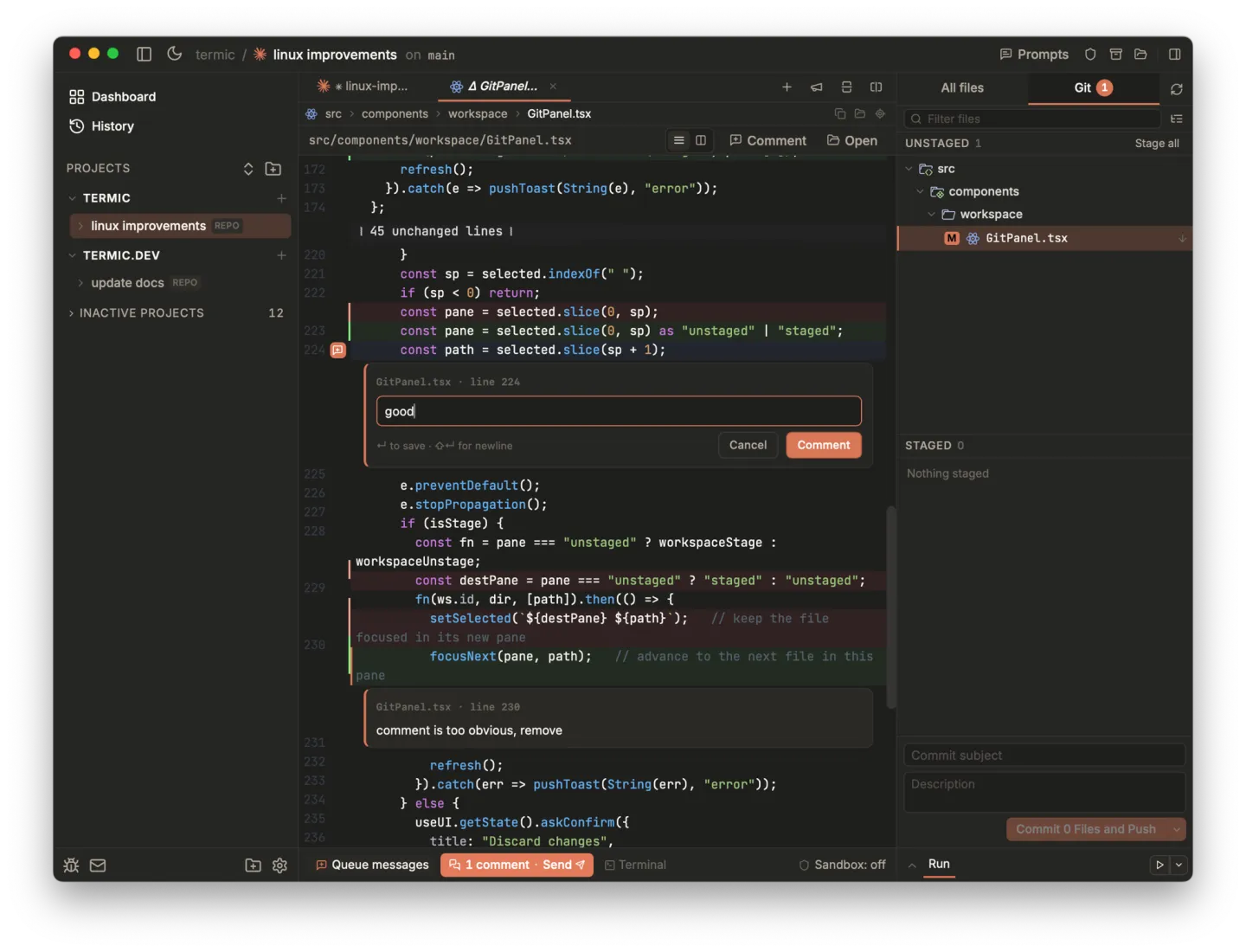
review
Review your agent's work like a pull request
The agent hands you a diff; you hand it back precise feedback. Select the lines that are wrong, leave an inline comment right where the problem is, and keep reading. Your notes stack up as drafts pinned to the diff - nothing is sent until you say so.
When you're done, one Send batches every comment into a single message - each with its file, line range and a quote of the code - and drops it straight into the agent. No retyping "the thing on line 224", no losing your place. It's code review, except the author turns your comments into commits.
Inline comments, in depth →spotlight
Run your whole stack, without touching your branch
Spotlight mirrors one task into your main checkout, so your real dev server, watchers and tests run against the agent's changes, live. A background watcher re-syncs within seconds, and Run executes at the main checkout in its own tab.
The safe part: Termic never writes a commit onto your branch. It checks the task out at the main checkout as a detached HEAD, so your branch ref never moves. Conductor's checkpoint commits can strand a leftover commit on your branch if cleanup doesn't run after a crash; Spotlight leaves zero commits behind, every time.
How Spotlight works →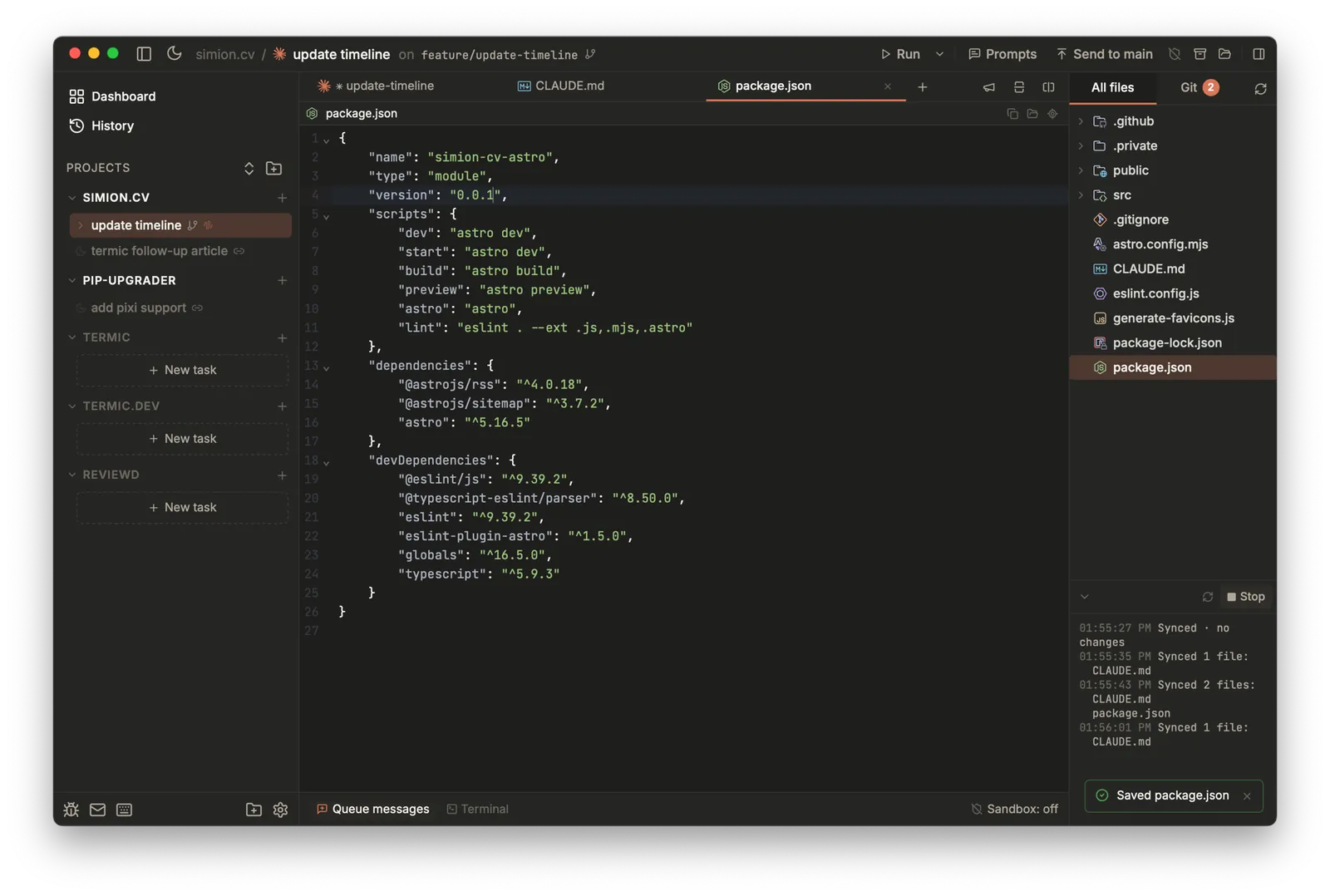
sandbox
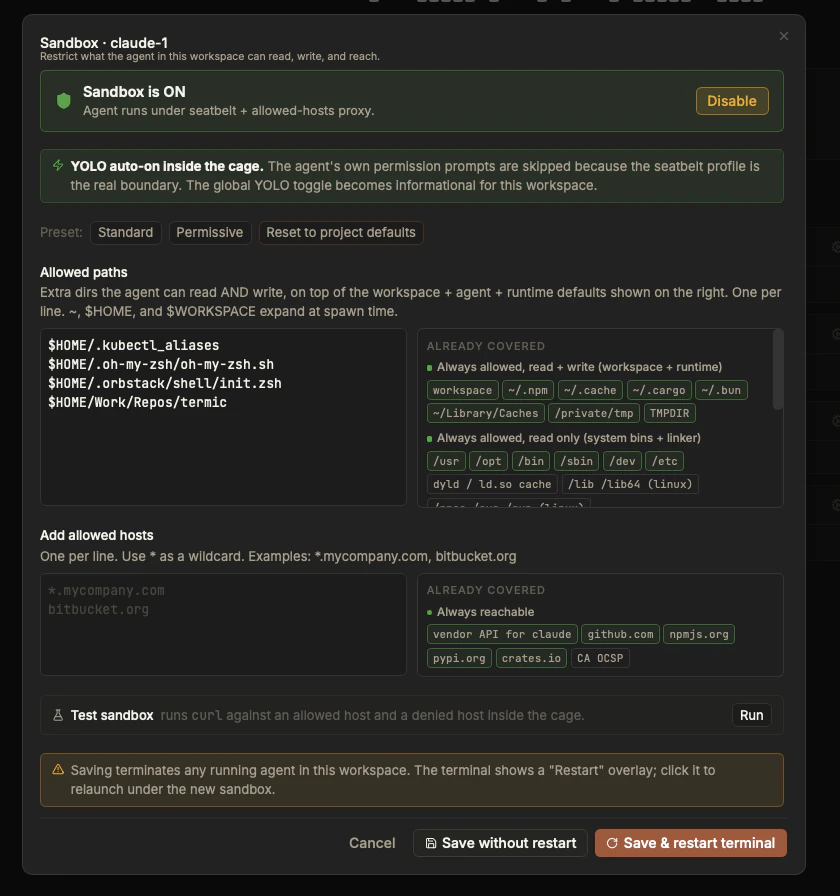
Cage the agent, not the workflow
Optional per-task macOS Seatbelt + an in-process HTTPS CONNECT proxy. Pinned at task creation, enforced from the moment the CLI spawns - no daemon to install, no per-prompt approval theater.
/Network allowlist
Every outbound request goes through an in-process Rust CONNECT proxy with a regex hostname allowlist. Per-CLI vendor APIs (anthropic / google / openai), GitHub, npm, PyPI, crates.io and CA OCSP are baked in; add your own per project. No tinyproxy, no sidecar - the proxy lives inside the Tauri binary.
/Filesystem allowlist
Default-deny via macOS Seatbelt. Only the task, the CLI's own caches and the toolchains it needs are reachable; everything else is blocked, read and write. So ~/.ssh, ~/.aws, ~/.gnupg, ~/.netrc, ~/.kube, Keychains, browser profiles, Mail, Messages and your personal folders are unreachable, even if the agent runs --dangerously-skip-permissions.
/YOLO without the YOLO
Inside the cage, the agent's permission prompts are auto-skipped - the seatbelt profile IS the boundary. Outside the cage, the toolbar lightning icon flips red as a deliberate danger signal. You always know which mode the task is in.
under the hood
Native desktop, web rendering
Tauri shell, web frontend. Editor and terminal are off-the-shelf libraries we picked after benching alternatives in WKWebView.
Rust backend, WKWebView frontend. ~10MB bundle (vs Electron's ~120).
UI. Vite HMR for dev, single bundle for prod.
Editor. ~150KB; Monaco was slower in WKWebView when we tested.
Terminal. WebGL renderer was the only one without visible row gaps in TUI apps.
PTYs on macOS / Linux / Windows. Same crate Wezterm itself uses.
State. No reducers, no thunks - just hooks.
questions
The actually-asked questions
Does this work with my Claude Pro / Max subscription?
claude CLI - same binary you'd run in iTerm, same auth, same subscription quota. Anthropic's June 15, 2026 Agent SDK credit change is scheduled to apply to the Agent SDK and claude -p; the interactive Claude Code CLI stays on the regular subscription usage limits.How is this different from Conductor.build?
gemini, Grok, Antigravity and custom PTY agents, has main checkout and multi-repo task modes, and can put each task behind a macOS Seatbelt sandbox plus network allowlist. Full comparison or best Conductor alternative guide.Does Termic see my prompts or read my code?
tail -f it if you want to see what's happening) - that's all. And you don't have to take my word for it: the whole thing is open source (AGPL-3.0), so you can read exactly what it does, build it yourself, and audit every release against the source.Can agents touch my secrets or hit random APIs?
~/.ssh, ~/.aws, ~/.gnupg, ~/.netrc, Keychains, Mail / Messages / browser profiles and your personal folders are all out of reach, read and write. Network is gated by an in-process CONNECT proxy with a per-CLI hostname allowlist (anthropic / google / openai + github + package registries baked in; add more per project). The sandbox is pinned at task creation - it can't be toggled on a live task, so an agent can't escape what it was spawned under.Is it actually open source?
Linux and Windows?
chmod +x, run. The in-app updater works the same as on macOS (the AppImage is signed with the same ed25519 key, and the updater replaces it in place). The Seatbelt cage is still macOS-only, but Docker mode is not, so a container cage works on Linux too; a native Linux equivalent (bubblewrap / landlock) is next on the list, and Windows is the platform after that.Stop paying twice for the same agent.
Free, AGPL-3.0. macOS + Linux now; Windows soon.
